Saturday, 23 March 2013

An Early Easter Egg Hunt


Another great day in my office!


I hear it is predicted to be the coldest March weekend for 50 years and snowing in most of the UK at the moment? 

UK readers skip to the next paragraph immediately…. 


Wild flowers in an olive grove on the Spanish border
            ….or weep as I describe the blue skies and warm sun in Portugal; how my spring fieldwork is not on landfill sites but mostly consists of wandering in sunny fields bright with spectacular purple, yellow and white drifts of wild flowers. The blossom is out on the fruit trees, swallows skim low over the gently nodding heads of vipers burgloss, lavender, rocket, lupins, dwarf iris and chamomile; and my footsteps through the long grass send butterflies scattering in to the air: Whites, Painted Ladies, Swallowtails and Blues. Did you know that all the UK’s Painted Lady butterflies are migrants? Neither these nor most of the swallows will be arriving in the UK for quite some time yet… 

This is Portugal at its finest, before the hot summer sun browns the meadow grass.  


First prize in my Easter egg hunt: shell plus contents!

Safe to read now...


It is not all paradise though. As well as tracking the logged birds (the subject of my next blog post) I have been visiting stork nests to see how many eggs have been laid, and to collect regurgitated pellets and egg shell -2 Easter egg hunts in one! 

Despite the wild flowers, the meadow directly below a stork’s nest is not a pretty sight –covered in smelly unsavoury poo and debris that I rummage through. Hunting through brambles, wildflowers and stands of tall nettles, eggshell is usually well hidden. Is that speck of white nestled deep against the soil a fragment of eggshell? Usually it is just light reflecting off a eucalyptus leaf, or a poo splatter, litter, a white stone or a bleached snail shell…. The anticipation of the hunt keeps me interested for hours!  

Similarly viewing in to nests to see how many eggs have been laid is like sharing a secret with each stork!


How many eggs have you laid so far...?


Storks usually lay 1-6 eggs but only manage to rear 1-4 chicks. Last year bad weather resulted in very bad breeding success. Keep following my blog to see if this year is a good or bad year for the storks breeding in Portugal.


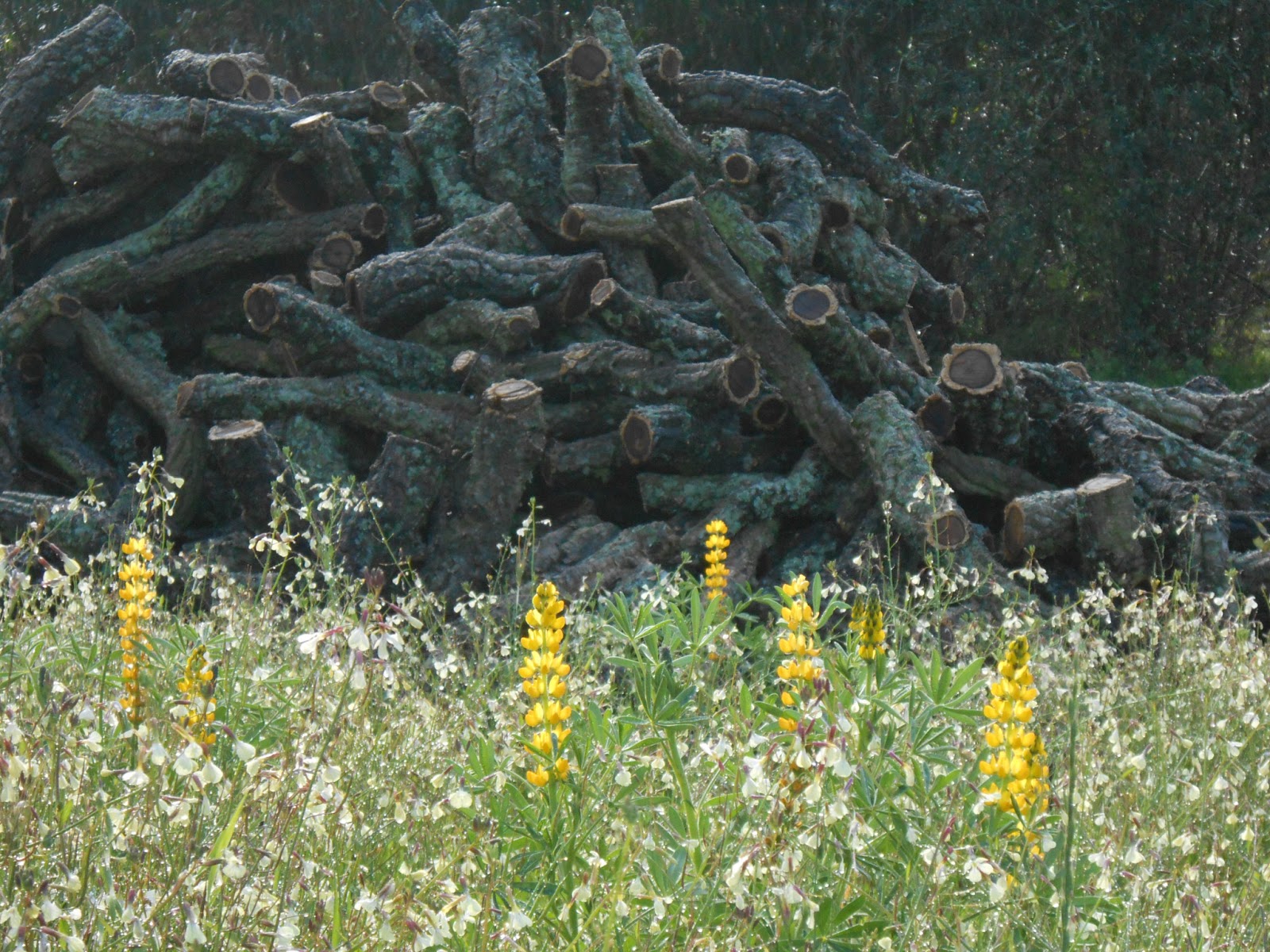
Im a bit wildflower obsessed after the long UK winter: Rocket, lupins and Cork Oak logs

Sunday, 10 March 2013

Field Season Begins!

Like planning a military campaign! Maps of all my colonies
Tomorrow I leave for not-so-sunny Portugal! It has been raining a lot there recently but hopefully this will not make the tiny country tracks too difficult to drive down because I want to visit the colonies of all the logged birds.

As you can see from the picture I have been studying high resolution maps marking the location of stork nests to see if any are likely to correspond to the nests of logged birds. I love maps so having many of them spread out across the table in front of me is right up my street. It feels more like being an explorer or planning a historic sea battle than putting the finishing touches to field work!

Next post from Portugal. I shall be visiting colonies at first and last light to see which nests are occupied and also tracking logged birds. Keep checking the BTOs website and my blog for the latest stork news!

Thanks to all of you who have donated to Support a Stork so far, your funds are hugely appreciated!

Thursday, 7 March 2013

Forensic Ecology

Gorgeous blue Roller feather samples plus cleaning chemicals
I use stable isotopes of Hydrogen, Carbon and Nitrogen from feathers and claws to determine if a bird wintered in Iberia or Africa. This is the bit of my research that non-scientists least understand, so how does it work?

In a nutshell a stable isotope is one of 2 or more naturally occurring forms of the same element. They demonstrate the same chemical properties and vary only in the number of neutrons in the nucleus. This means the only difference between them is a slight variation in weight. They are stable because they do not decay over time like radioactive isotopes. In food webs the heavier isotope is usually less common than the lighter form and I measure these tiny differences in weight ratios in a mass spectrometer.


Samples are weighed out into tin capsules and folded very small
Fractionation. Various naturally occurring biochemical processes (eg rainwater evaporation, body metabolism) alter the ratios of stable isotopes at the base of the food chain (fractionation) and these isotopic signatures are taken up by all species through diet and drinking water and become permanently fixed in hair, nails and feathers after growth. This means the stable isotope ratios in my feathers and claw samples reflect the values in the local food web where they were grown and are unchanged when a bird migrates to a new, isotopically distinct location. From this inferences can be made about the location where the feathers were grown.


My Analysis. At the moment I am simultaneously analysing Carbon (13C/12C) and Nitrogen (15N/14N) -expect a blog about Hydrogen (2H/1H) later. Nitrogen is used to distinguish trophic position in the food chain and to detect changes between marine and freshwater diets; not so applicable for my birds so I am more interested in Carbon.

The 2 furnaces for the mass spectrometer. The red 'Vecstar' furnace for C/N next to the 'Costech' furnace used for H
Forensic Ecology. Carbon isotopic ratios indicate what sort of habitat the feather/nail was grown. This is because C3 and C4/CAM photosynthetic pathway plants fractionate Carbon isotopes differently by each using a different enzyme to grab CO2 out of the air at the first step of photosynthesis. Most temperate latitude plants are C3 pathway species (eg wheat, potatoes). C4 plants (eg sugarcane) dominate in tropical and subtropical latitudes and have higher d13C ratios than C3 pathway plants. This means I can tell what sort of plan life was at the base of the food chain where the feather was grown and this helps me decide whether the bird spent the winter in a temperate or (sub)tropical region.

It is all pretty amazing! –but not without various problems in data interpretation which I am sure I shall go in to (read: rant about) at some point!


The output screen: 2 square peaks of reference gas, then a small Nitrogen peak. The jump to Carbon (more visible as a line in the top graph) then a taller Carbon peak and 2 square reference peaks -the second just being produced. The Carbon peak is taller because feathers contain more Carbon than Nitrogen.


Friday, 1 March 2013

Friday, 22 February 2013

This Blog Is Not Just About Birds -a non birdy post to prove it!

 
Snow on the awesome cliffs at Hunstanton on the undergrad field trip
This blog (and my PhD) is not just about birds. 

Assisting on fieldtrips is always a welcome change from being desk or lab-bound –and not badly paid either! Yesterday I went to Hunstanton on the Norfolk coast to assist on an undergrad fieldtrip for the 'Earths Chemical Processes' module.  I enjoy delving back in to my old undergrad territory of Earth Sciences.

The coast always looks beautiful with the huge expanse of sweeping sand and the distant wind turbines out over the flat sea –if bitterly cold! Both years I have assisted on this fieldtrip snow has been falling. 

The cliffs at Hunstanton are very striking. They tell a tale of slowly rising sea level from the dark brown estuarine conglomerate at the base, through the warm brown carstone sand deposited just offshore; and continuing up to the red and white chalks laid down over millions of years far from land in a warm, deep sea. As my group chipped samples from the cliffs with geological hammers ready for lab analysis next week, we encountered fossils: belemnites (extinct squid), echinoids (sea urchins) and fossil worm burrows. Apparently you can find sharks teeth here too, although I never have despite many visits collecting samples for various workshops. If anyone has found sharks teeth here let me know, my optimism for finding a sharks tooth in the Hunstanton geology needs topping up!

Wednesday, 20 February 2013

And We're Live!

Where is Goncalo now? Find out on the BTOs live interactive map!
How exciting! The stork pages are now live on the website of the British Trust for Ornithology:
http://www.bto.org/science/migration/tracking-studies/stork-tracking

An extra special welcome if you have found me from the links on the BTOs website.


Field season is approaching so I will be updating the BTOs blog and my blog here on a regular basis. At the moment I am busy in the stable isotope lab but have flights booked to head out to Portugal in mid March to start following the breeding season in my colonies up and down Portugal. Expect updates on lab and field work, logged storks and the beautiful country of Portugal soon. Click to follow my blog and get all the news as it happens! Plus the stork movements will be uploaded daily to the map on the BTOs website so keep checking the whereabouts of the birds.

Thursday, 14 February 2013

The Mystery of 35+

Have you taken your logger off, Daniel?
At the end of January logger 14 started transmitting overlapping GPS co-ordinates, signifying it was not moving. Was the bird dead or had he somehow lost his logger? I am in UK at the moment working in the lab (a blog post on that soon) and preparing to fly out to sunny Portugal for the start of my next field season, so Carlos Pacheco kindly went to the site. It is a pretty, rural location between the towns of Castro Verde and Beja in South-central Portugal. White Storks flew off from about 30 nests but, despite searching, there was no sign of the logger or a dead stork. This means there are now 14 active loggers instead of 15, but the good news is it seems Daniel is not dead. Perhaps he managed to remove his logger and it is lying out of sight in a nest? I shall up date you on whether I manage to catch sight of Daniel when I visit this location in a few weeks. If any of my readers are out in Portugal and see blue ring +35 do let me know. See 'How You Can Help' tab for more details.
I had hoped to recover all the loggers when they fall off (hopefully later rather than sooner!) by visiting the location of the overlapping co-ordinates, it looks like this one may have escaped!